
What is a brand point of view and why does your brand need one?
POV isn’t a trend. It’s your foundation for growth.
A brand point of view is what your brand believes, what it stands for and how it sees the world. Then it says so clearly and consistently. It's the opinion behind your marketing. Without one, you sound like everyone else. And when customers can't tell you apart, they choose on price.
How is a brand point of view different from positioning?
Positioning is the where. Where you sit in the market and how you compare with competitors.
Point of view is the why and the how. Why you believe what you do, and how you see things differently.
Put simply: positioning is the market landscape. POV is the opinion.
It isn't your tagline. It isn't your logo. And it's never borrowed from a competitor.
Why are so many brands losing their voice?
Three forces are flattening brands right now.
Everyone is using the same AI. Same models, same frameworks, same copy. Brands start to sound like their competitors, and nothing separates one from the next.
Budgets are under the microscope. When every dollar has to prove its ROI, brands play it safe. Safe doesn't stand out.
Trend-chasing has replaced conviction. Algorithms reward reactive content, so five brands jump on the same trend in the same week. None of them own it. They borrow attention without building anything people link back to them.
What does a weak point of view cost your brand?
When customers can't tell brands apart, they find another way to choose. Usually, that's price. And someone will always be cheaper.
The data supports this. HubSpot's 2026 State of Marketing report found 61% of marketers agree that expressing your taste and brand POV is essential to a successful AI strategy. Yet just 52% of organisations have a clear, well-defined value proposition that sets them apart.
That's nearly half of brands investing in campaigns without a clear reason for anyone to choose them.
Does investing in brand actually pay off?
Yes. Brand builds mental availability: the likelihood a customer thinks of you in a buying moment. (If you haven't read Byron Sharp's How Brands Grow, start there.)
You can't always connect a straight line from campaign to checkout. But you can see brand move consumer behaviour. In a sponsorship our Founder, Gen, led for Trojan with Melbourne United, sponsor recognition rose from 73% to 95% in a single season. Trojan ranked among the top four most recalled sponsors in NBL25 and NBL26.
That's what a clear, consistent brand presence does. People remember your brand and the memorable experience they created.
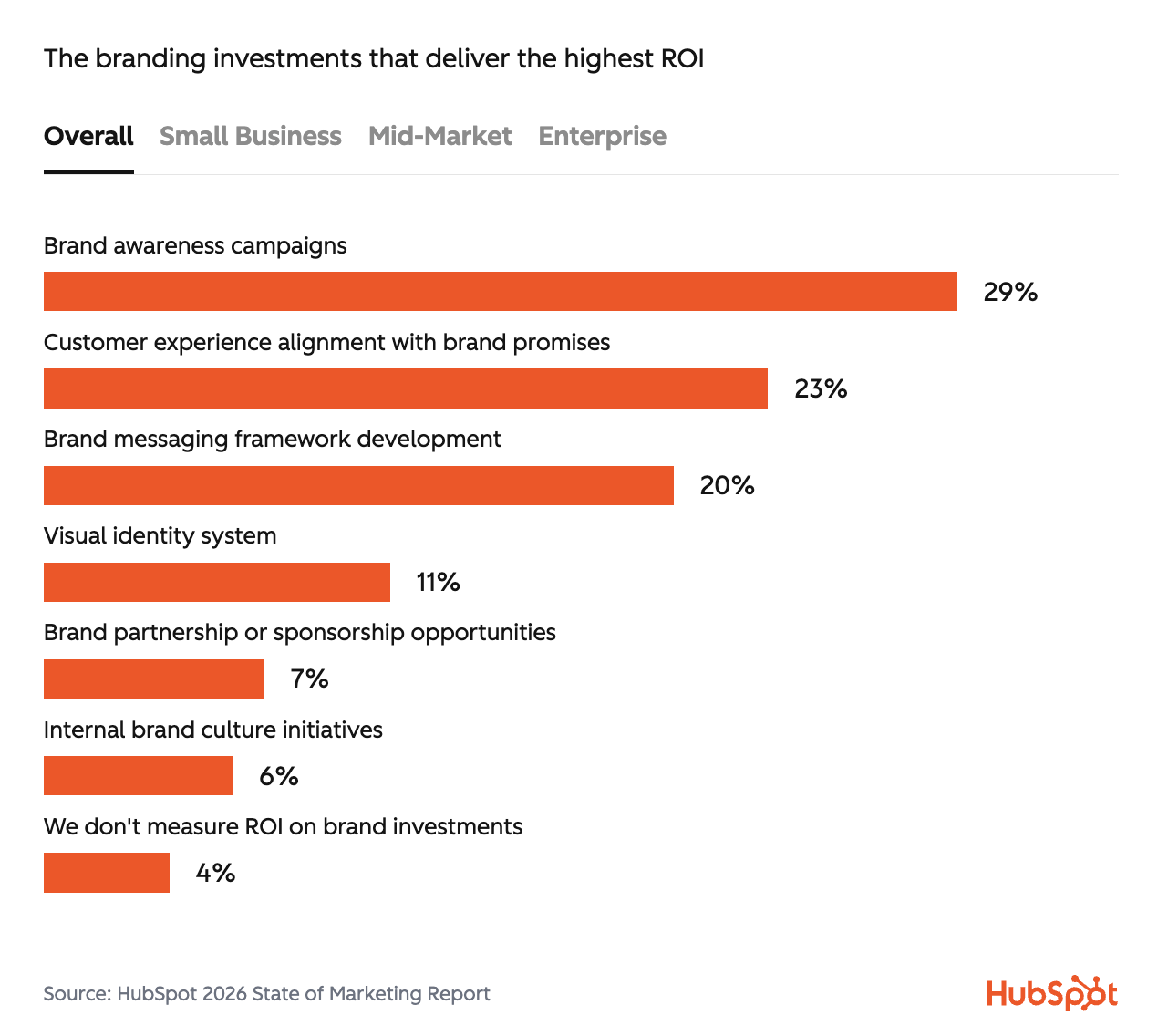
HubSpot breaks down the brand investments and initiatives that deliver the highest ROI below:
How do you define your brand's point of view?
Audit what you already have. Review your brand assets, guidelines, customer data, competitor benchmarks and positioning. Know where you stand before you decide where to go.
Find out how customers really see you. Not how you want to be seen. Use CRM data, reviews, sentiment research and customer feedback. (More on this in How well do you really know your customer?)
Name your special sauce. What makes you different, and why do customers choose you over the alternative?
Write down what you believe. What does your brand stand for? What would it argue for in your industry? What would it never do?
Show up consistently. A POV only works if people see it again and again: on your website, in social, in PR and in every pitch.
Use AI as a tool, not a voice. AI is brilliant for speed, research and first drafts. Your POV must come from the people who know the brand inside out.
Most marketing teams now revisit their brand quarterly or annually, according to HubSpot.
Many validate their positioning with data: 61% run brand perception surveys and 56% monitor engagement after a positioning shift. Your POV should evolve with your market, not drift with the latest trend.
Ready to define your brand's point of view?
That's where HEAT. comes in. We help ambitious brands discover their unique edge and communicate with confidence, and impact.
Good questions about brand POV.
-
Positioning defines where your brand sits in the market relative to competitors. Point of view defines what your brand believes and how it sees the world. Strong and memorable brands need both.
-
AI can help you research and draft. It can't decide what your brand believes. That judgement has to come from the people who know your business, your customers and your industry.
-
Check it at least once a year, or whenever your market, offer or audience shifts. Your core beliefs should stay steady. How you express them can evolve.
-
No. Small and growing brands often benefit most, because a sharp POV helps them compete on something other than price or media spend.