
What is AEO?
How to get your brand into AI answers in 2027.
AEO (Answer Engine Optimisation) is how you get your brand mentioned and cited in the answers AI gives. Your customers already ask ChatGPT, Gemini and Perplexity for recommendations. AEO decides whether your brand is mentioned in the answer.
Planning for 2027 is underway. If your content plan doesn't include AEO and SEO, there’s a gap to consider.
We recently attended CONNECT with HubSpot in Sydney. Two sessions tackled the same question: how do you get your brand into the answers AI gives?
Here's what we learned, and where to start.
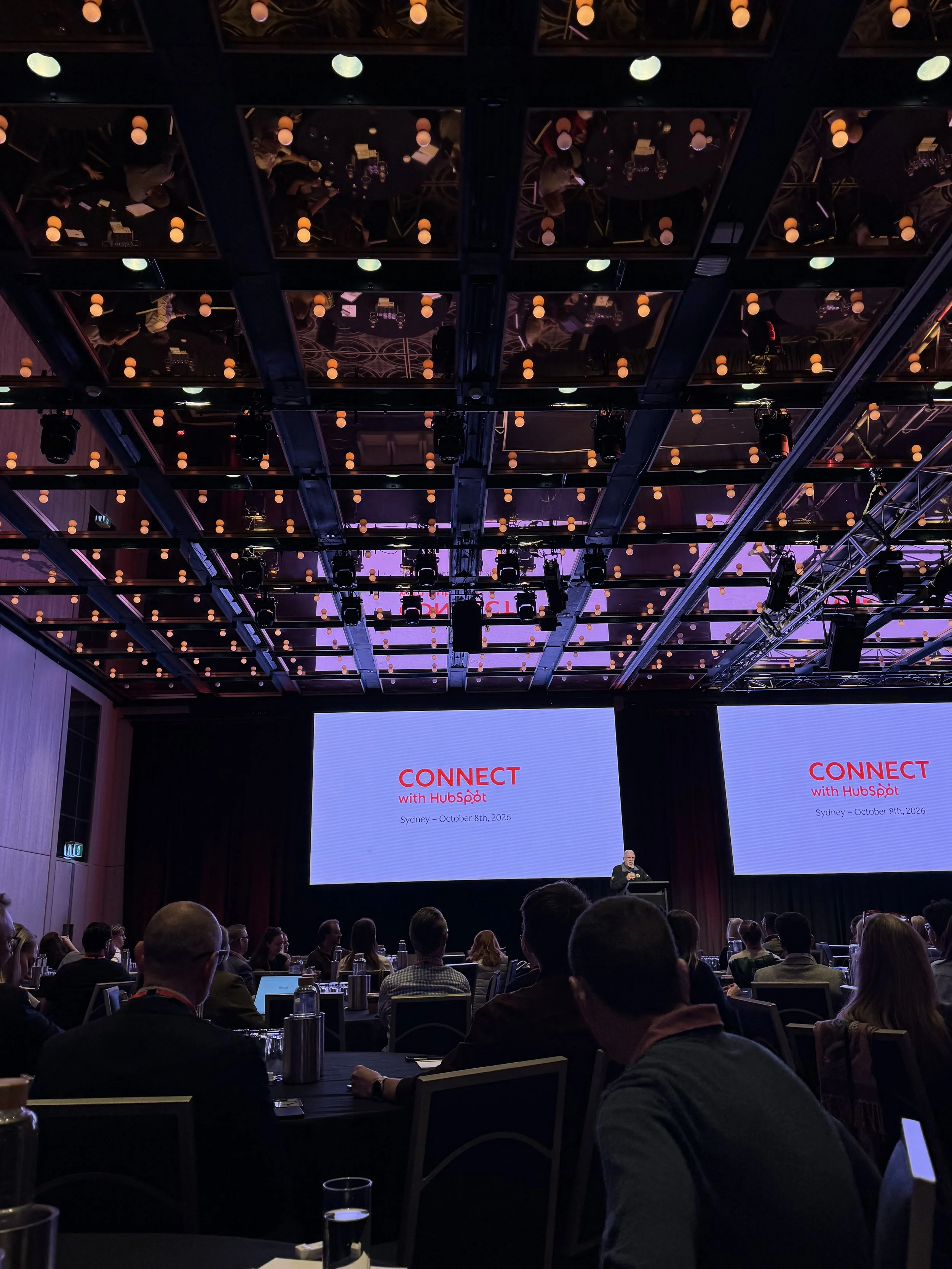
CONNECT with HubSpot brings together marketing and sales professionals to share knowledge and develop capability.
Why does AEO matter now?
Because your customers are already asking AI to answer their questions and solve their problems. That's not going anywhere.
The research supports this:
AI assistants now receive 45 billion sessions a month worldwide. That's 56% of the size of search globally and 34% in the US (Graphite, 2026).
That counts every use of AI. Look only at search-style questions and AI is still 28% of the size of search worldwide.
McKinsey projects that US$750 billion in US revenue will flow through AI-powered search by 2028 (McKinsey, 2025).
AI search matters. To stay ahead, or even to compete, you need to know whether your brand is the source being cited or the one being left out.
The good news: you're not behind yet. McKinsey surveyed CMOs at Fortune 500 consumer brands and found just 16% systematically track AI search performance. Start now and you'll be ahead of many other brands.
How is AEO different from SEO?
SEO gets your pages ranked in search engines. AEO increases how often, and how accurately, AI answers reference your brand.
AEO doesn't replace SEO. A strong SEO foundation is critical for AEO. But AEO covers a channel SEO alone doesn't reach, and both belong in your content marketing strategy.
Three terms you need to know:
Visibility: how often AI platforms feature your business.
Mentions: your brand appears in an AI answer without a link.
Citations: the clickable sources in an AI answer.
How does AEO work?
Someone asks a question. The answer engine responds with recommended brands. To make that recommendation, it pulls information from multiple sources.
The way to win is consensus: many independent places saying the same thing about your brand.
What did we learn about AEO?
Your website is only part of the picture
HubSpot data shows earned media (30%) and peer sites (27%) supply more than half of AI citations. A brand's own website supplies 8%.
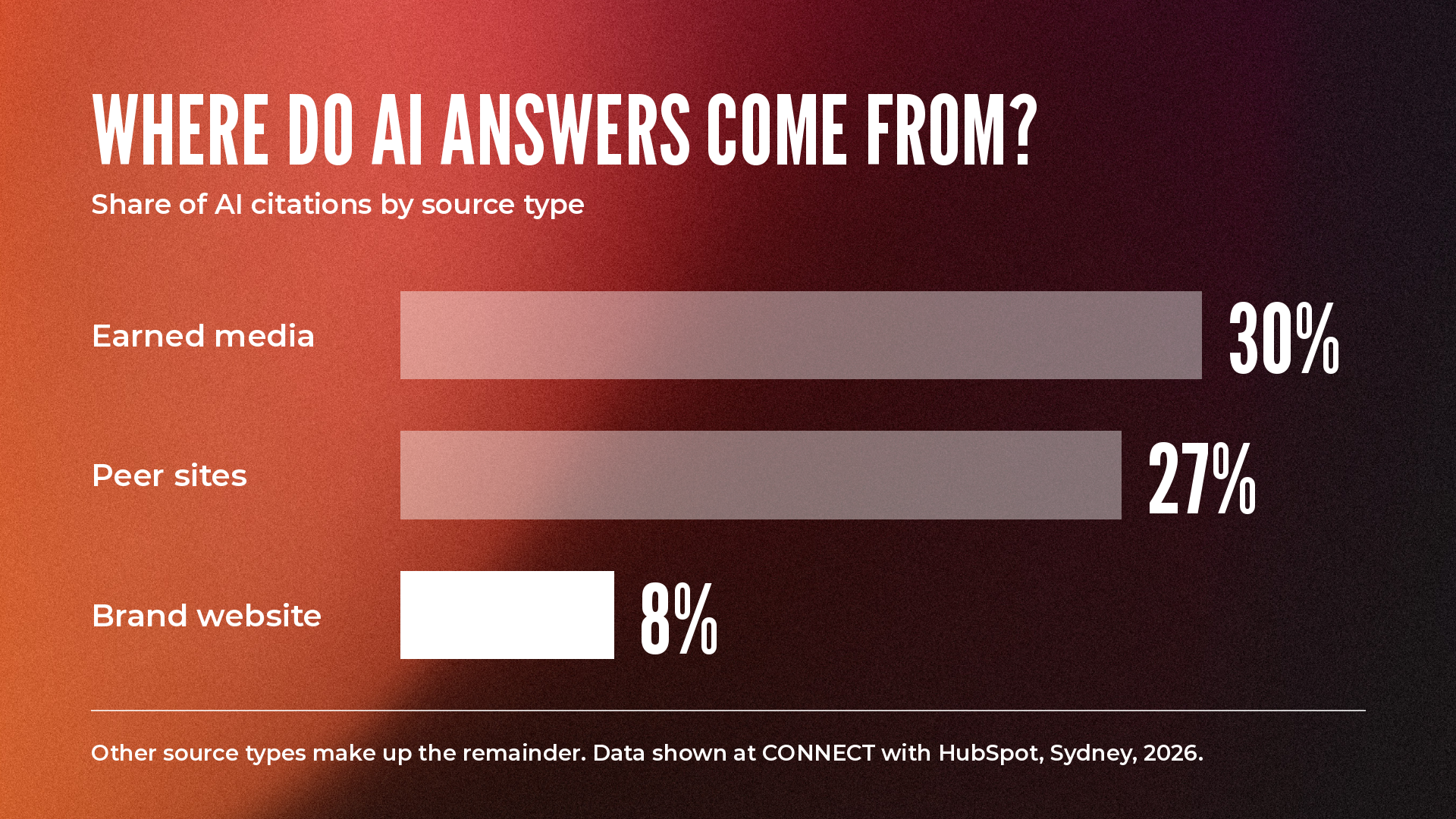
McKinsey's research backs this up. In many cases, a brand's own sites make up only 5 to 10% of the sources AI search references.
Most brands put the bulk of their effort into content for their own website. That's still important, but PR, partner content and industry listings are essential for brand visibility too.
Backlinks don't work for AEO
Google looks for the most authoritative page. Answer engines look for snippets that answer the question, so trust signals carry the weight.
LinkedIn, YouTube and Reddit build that trust, and they matter most when buyers are close to a decision: 55% of the citations from those platforms sit at solution evaluation and final research.
Action: choose a primary channel for your brand and produce content that builds genuine trust. Customer testimonials in video form are a great place to start. You nail two things at once: brand trust and short-form video.
Blogs are here to stay
LLMs love blogs. One speaker at the event framed it well: LLMs go to the blog for information 90% of the time. But the content has to be specific.
Action: answer the question clearly, then give the detail around it. Frame your headings as questions, add an FAQ section and include data only you have: stats, figures and case study outcomes.
Freshness matters more than ever
Ahrefs analysed 17 million citations and found the content AI assistants cite is around 25% fresher than what ranks in traditional search.
Action: refresh your web pages regularly with new stats, quotes and details, and show a last-updated date. We're doing the same on our own pages.
Where do you start with AEO?
Start small. Don’t let the overwhelm of AI get to you. Pick one or two of these four steps and do them well.
Rewrite your top 5 pages. Refreshed content is key.
Publish 5 case studies or customer persona pages. Frame each one around how your brand solves a specific challenge for a specific industry.
Share that fresh content on the right channel. Choose a primary channel from YouTube, LinkedIn or Reddit and build a content plan for it.
Measure your visibility over time. Free tools will get you started. HubSpot’s AEO Grader scores how your brand shows up across ChatGPT, Perplexity and Gemini. Run it again each month to identify trends.
Only have time for one thing? Start with your case studies. They work for every brand, whatever the industry. They build trust with your audience and with AI, which is key to increasing visibility through AEO. Make them data-driven, with numbers, soundbites and a video version.
What doesn’t change?
The thinking. One of the core messages from the event: the more AI grows, the more human critical thinking matters. The tools are only as good as the people applying them.
Context matters. And who provides the context? You do. The human.
That’s where the right partner helps.
Need support with your AEO strategy?
HEAT. can help. We’ll work with you to build AEO into your 2027 content plan: refreshing the pages that matter, creating case studies worth citing, and planning the channels that build trust.
Let’s put your brand in the lead in 2027 – book a free 15-minute chat.